

IU McKinney Students Take Part in Research Projects with State Department
02/22/2016
Law students and alumni of IU McKinney took part in the U.S. Department of State’s Diplomacy Lab during the Fall 2015 semester.
The effort is part of the State Department’s Diplomacy Lab, a program in which faculty and students develop ideas and solutions to policy issues identified by the federal agency. The program was launched by Secretary of State John Kerry in 2013. The effort toward gaining IUPUI’s involvement in the Diplomacy Lab project was led by Professor Gabriel Filippelli of the Department of Earth Sciences. He had served for a year in a science advisory position at the State Department after he was named a JeffersoScience Fellow in 2013.
Teams completed research projects for the State Department; the work was part of the wider participation by the IUPUI campus in the effort. Professor Filippelli ran a project on freshwater security in the Arctic during the Fall 2015 semester. Other topics examined by IUPUI students during that time included water resource analyses and port security. Spring 2016 projects are on media products for passport services offices. IU McKinney bid on two projects and was successful. Professors Shawn Boyne and Fran Watson conducted research on the topic: “The Role of the Public Defender.”
Students and recent LL.M. alumni involved in researching public defender systems included Sadia Maqsood, LL.M. ’15, and Ngoc Tran, LL.M. ’15, who researched Asia; 3Ls Kenneth Enright and Matthew Schlegel who researched Europe; 2Ls Chandler Carney and Stephanie Rivas who researched South America; and 2Ls Nasha Baughman and Matthew Whitlock who researched sub-Saharan Africa.
“The students have done a great job working on this project together and in communication with the State Department,” Professor Boyne said of the student’s efforts. Those who took part in the project may have an opportunity to present their research during the Student Project Fair at the Marshall Conference Center at the U.S. Department of State in Spring 2016.
What follows is a glimpse of the students and their motivations for entering into the project.
 Asia: Ngoc Tran (left) and Sadia Maqsood researched Pakistan, Japan, Vietnam, and Thailand.
Maqsood is originally from Pakistan, and has worked on pro bono cases for clients there. She said the experience showed her defects in the system that makes access to justice for the indigent nearly impossible to obtain. In addition, there are no incentives for lawyers there to do pro bono work, and the public in general is unaware of the help that is available to those without means to pay. “This project will enable me to conduct research about legal aid systems in different countries in a broader way and help me in bringing changes to the current Pakistani public defender system, which will best suit my country.”
Ngoc worked in her native Vietnam providing legal aid to those of limited means. She wanted to become involved in the project so she would be in a stronger position to advocate for change at home. “The very first thing I want to see changes in is the encouragement of pro bono,” she said. “We currently have little motivation for lawyers to do pro bono and a good public defender system requires pro bono.”
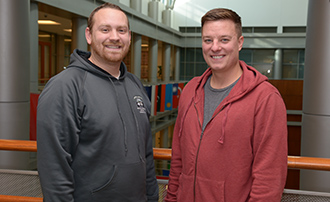 Europe: Kenneth Enright (left) and Matthew Schlegel researched Kosovo, Germany, Spain, and Armenia.
Enright enjoyed the opportunity to do research in a different way. “I thought it would be beneficial to learn how to research something other than ‘legal’ issues, as I feel this has some real world applicability that solely writing briefs cannot provide a law student,” he said. He would like to work in government service at the federal level after graduation.
European Union Law and International Business Transactions are Schlegel’s favorite areas of study, and the opportunity to learn more about the EU, even in an area of law outside his particular interest, was appealing, he said. “When I heard about the project and found out that it will be used by our State Department to give useful advice to newly formed countries and their legal systems I knew I wanted to be a part of that,” Schlegel said. “There are few opportunities to help people on a large scale and I truly wanted to be a part of one.”
 Latin America: Chandler Carney (left) and Stephanie Rivas conducted research on Chile, Columbia, Chile, Honduras, and Mexico.
Carney was drawn to the region because she lived in Costa Rica and in Chile, and is interested in pursuing a career in the region. “When I received the email about the Diplomacy Lab, I knew right away that it was something I would be very interested in,” she said. “I have already learned so much about the civil law system, the effects of colonization, and the development of the rule of law. I think that the project is closely associated with the type of work I would like to pursue.”
The timing couldn’t have been better for Rivas to learn of the project; she had just completed an externship in the prosecutor’s office in Louisville, Kentucky, where she lives. “During that externship, I had the opportunity to speak with some of the public defenders about their positions and how difficult it is to truly provide adequate representation,” she said. “Because of this experience and with all the events occurring throughout the world, I have felt this desire to somehow find a way to help others who do not have any resources. I am hopeful that we can provide specific guidance that will help these regions to reform and improve their public defender systems.”
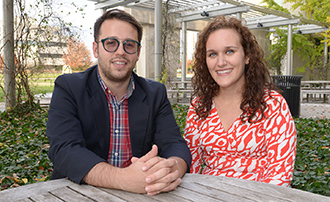 Sub-Saharan Africa: Nasha Baughman (right) and Matthew Whitlock examined South Africa, Ethiopia, and Cote D’Ivore.
“The Diplomacy Lab appealed to me because this project lets us step outside the classroom to explore concerns that are currently facing legal systems abroad and assist with the implementation of future policy,” Baughman said. “I sought this experience to broaden my understanding of legal concerns and vulnerabilities that exist throughout the globe.”
Whitlock expressed similar sentiments. “The Diplomacy Lab offers an opportunity to explore an area of law practice that, for me, is the lifeblood of a law student’s pursuit of justice as it relates to society – policy that shapes the tools at an attorney’s disposal to effectuate change in a political state,” he said. “It is a perfect opportunity for those of us working on the project, myself included, to challenge ourselves to ask what works, what doesn’t, and what we can do to help create meaningful change.”
