

News Archive
Inside-Outside Law Class Makes Impact
06/29/2017
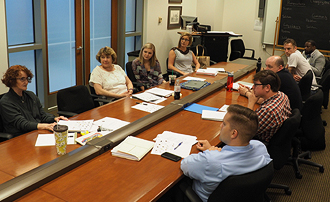 The course was the first-ever Inside-Out Prison Exchange Program offered through the law school with a combined enrollment of 22 “inside” students at the Indianapolis Re-Entry Facility (IREF) and “outside” McKinney law school students, who together explored how the legal system helps to construct society’s perceptions of race, citizenship, and crime.
IU McKinney Professor Shawn Boyne was looking forward to teaching the summer course, "Race, Citizenship, and Crime.”
The course was the first-ever Inside-Out Prison Exchange Program offered through the law school with a combined enrollment of 22 “inside” students at the Indianapolis Re-Entry Facility (IREF) and “outside” McKinney law school students, who together explored how the legal system helps to construct society’s perceptions of race, citizenship, and crime.
It came to an unanticipated ending three weeks earlier than expected, however, with the recently announced closing of the minimum-security prison facility. The Indiana Department of Corrections said the closure was intended to save costs and was brought about by changes in legislation that limited the number of inmates being sent to facilities like the IREF. Inmates, including the “inside” students at IREF were suddenly relocated to other nearby prisons.
The “outside” students will continue to meet to finish up their class project, which will look at barriers to re-entry for inmates held in the state system.
Despite the change in plans, 2L Grace Drasic said the class was “incredible, one of the most impactful experiences of my life.”
“There was no divide between the ‘inside’ and ‘outside’ students. I forgot they were inside students. They were just my classmates,” Drasic said. “We learned so much from each other and it gave me so much insight into the criminal justice system.”
From the first class meeting, students collaborated on in-class assignments, submitted papers and read from the same texts including some of the newest books on the causes of mass incarceration. Through weekly discussions and interactive exercises, the students in the course gained a deeper understanding of the subject matter.
According to Professor Boyne, in one illuminating exercise, the “inside” [inmate] students did a role play exercise with the “outside” [law] students, who played the role of the client’s public defender after a case had concluded. During the role play, the “inside” students shared their confusion and disappointment with the quality of their representation.
“The ‘outside’ students were instructed to use active listening techniques to understand the source of their client’s frustration,” Boyne said. “The class then reversed the roles. It was a challenging experience for everyone.”
After a rigorous first year of law school, McKinney student Eden Strange said he is approaching his second year of law school “rejuvenated” by the Inside-Out course. “The things we are studying in law school have impact on real people, and this course gave us insight into that,” he said. “It reminded us that we are actually preparing to practice law for real people. It helped humanize the law for us as law students.”
The Inside-Out Prison Exchange Program, which was founded at Temple University in 1997, trains individuals to conduct classes inside prisons and re-entry programs. Professor Boyne is one of more than 700 professors worldwide who have completed training in the inside-outside teaching pedagogy. She completed the 7-day, 60-hour intensive training at the Oregon State Penitentiary in 2014.
Professor Boyne teaches criminal law, criminal procedure, cybercrime, and national security law. She is a Senior Mosaic Faculty Fellow and serves as co-director of evaluation and assessment at IU McKinney
Although several IUPUI professors have taught undergraduate-level inside-out courses, this marks the first time that an inside-out course was offered at IU McKinney.
“If I could make this a required course, I would,” Drasic said. “It makes me very sad that the time was cut short, but this five weeks had a big impact on my life.”
