

News Archive
Top Foodborne Illness Litigator Visits McKinney
09/24/2018
Food production is a risky business and by failing to improve food safety, the industry runs the risk of poisoning consumers and attracting expensive litigation, according to William D. Marler of Marler-Clark, The Food Safety Law Firm in Seattle, Washington.
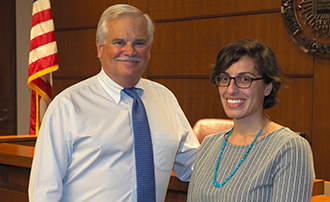 Marler, who spoke September 13 at the first event of the Hall Center for Law and Health Grand Rounds lecture series at the IU Robert H. McKinney School of Law, has been litigating foodborne illness cases for over two decades. He was introduced by IU McKinney Law Visiting Professor Aila Hoss (left, with Marler).
One of his first cases was that of Brianne Kiner, a victim of the 1993 Jack in the Box E. coli outbreak. She was nine years old at the time and suffered one of the worst illnesses resulting from the restaurant’s decision to serve undercooked hamburgers. Days after eating the Jack in the Box burger, Kiner was admitted to Seattle’s Children’s hospital, slipped into a coma and was expected to die. She recovered, but still suffered permanent conditions, including diabetes, asthma, and kidney problems.
Marler represented hundreds of other victims in the Jack in the Box outbreak in a class-action suit against the company, as well as victims of nearly every large foodborne illness outbreak in the United States.
He has filed lawsuits against such companies as Chili’s, Chi-Chi’s, Cargill, ConAgra, Dole, Excel, Golden Corral, KFC, McDonald’s, Odwalla Peanut Corporation of Maerica, Sheetz, Sizzler, Supervalu, Taco Bell and Wendy’s, securing more than $600 million for victims of E.coli, Salmonella, and other foodborne illnesses.
Restaurant chains and other food producers are under pressure from Wall Street in an increasingly competitive, global environment, and they also sense a lack of clear rewards for protecting food safety, Marler said. According to the U.S. Centers for Disease Control and Prevention, 48 million Americans get a foodborne illness each year and 125,000 are hospitalized. Three thousand Americans die as a result.
“At Marler Clark, people who have gotten sick and believe that their illness resulted from consumption of a particular food item call us virtually every day,” he said. “You would think that with that number of cases, I would have the biggest law firm in the country.”
One reason he doesn’t, he says, is because figuring out causation is sometimes a challenge.
Each foodborne pathogen carries with it an expected incubation period—the amount of time expected to transpire between exposure to the pathogen and the onset of symptoms. Incubation period is an important indicator in screening a case, according to Marler, who noted that some common foodborne pathogens have incubation periods of one to eight hours and others much longer—up to 70 days for listeria, for example.
Marler uses four primary tools in evaluating a claim: Health department investigation of an outbreak or illness, prior health department inspections, medical records and lab results.
During his McKinney lecture, he reviewed some of the high-profile cases his firm has won, and discussed how food companies can identify potential hazards and avoid litigation. He recommended that food companies establish relationships with public health officials, and hire good people who care about food safety.
“Companies need to step up,” Marler said.
Upcoming Hall Center Grand Rounds lectures include:
- “Regulatory Silence at the FDA: Impact on Access and Innovation” with Jordan Paradise, Georgia Reithal Professor of Law, Loyola University Chicago School of Law on Thursday, October 4 at 4:30 in the Wynne Courtroom.
- "Legal Alternatives to Guardianship – Means to Assist Incapacitated Individuals Without Fully Taking Away Rights” with Rebecca W. Geyer, Founder of Rebecca W. Geyer & Associates, PC on Thursday, October 26 at 4:30 p.m. in the Wynne Courtroom.
All events are free and include 1.0 hour of CLE, but registration is required. For more information, visit mckinneylaw.iu.edu.
