

News Archive
Faculty Use Improvisation Comedy Skills in the Classroom
10/12/2018
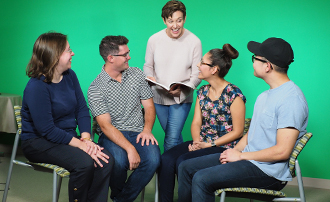 It’s no joke: IU McKinney Law Professors Yvonne Dutton and Margaret Ryznar spent part of the summer polishing their skills in improvisational comedy.
They hope to share with McKinney law students some of the improv skills they’ve learned from The Second City, best known as the first-ever, ongoing improvisational theater troupe based in Chicago, with locations in Hollywood and Toronto. It’s a form of theater in which what is performed is created in the moment, without a prepared or written script, as the players collaborate on the dialogue, action, story and characters.
Professor Dutton will share with students what she’s learned at a two-hour Improvisation Workshop on Saturday, November 3. The workshop will include improvisation games to build skills in collaboration, teamwork, active listening, effective communication, and creativity. Open to 14 students, the workshop quickly met its quota, and Professor Dutton is considering offering a second program at a later date.
Professor Dutton (pictured, center) provided a preview video, featuring Professor Ryznar (above, from left) with 3L law students J. Mitchell Tanner, Erika Flores, Samyoul Kim trying out the games.
Professor Dutton took classes in June in Los Angeles, while Professor Ryznar took Second City stand-up comedy, storytelling, improv, and writing classes in Chicago during June and July.
While most of their summer improv classmates were interested in pursuing careers in entertainment, Professors Dutton and Ryznar are interested in how the comedy theater techniques can help law students—and law professors—hone skills that will aid them in life and in their profession.
Improv actors do not know what will happen on stage until they are there in front of the audience, Dutton said. They improvise, but they draw on the “yes, and” technique: they accept whatever their colleagues do or say and then build on it with their own contributions.
To do this, good improvisors need to be fully present, listening carefully and thinking, while conveying to the audience that they are “on top of it” – not worried about what’s coming next, Dutton said.
“Improvisation techniques can improve your lawyering skills,” Professor Dutton said. “Lawyers have to think on their feet, too, and make on-the-spot decisions. They have to process and respond creatively to information that is constantly changing. They must convey confidence and use body language, tone of voice, and facial expressions to communicate with clients, judges, and juries.”
“You’re never supposed to show you are shocked if the judge asks you a question, you’re supposed to be composed,” she said.
Dutton is a veteran of the stage. In addition to her distinguished legal and teaching career, she was a Broadway singer and dancer, performing in Singin’ in the Rain and 42nd Street.
At IU McKinney, she uses the Socratic method in teaching her law school students. The method, named after the classical Greek philosopher Socrates, employs an argumentative dialogue between individuals, based on asking and answering questions to stimulate critical thinking and to draw out ideas and underlying presumptions.
“It’s an approach that can leave some students frozen with a deer-in-headlights look, even when they know the material,” Dutton said.
“I frequently see students with stage fright, but improv skills can help students stay cool,” she said. “Why wait until you are in front of the client, the partner, or the judge to hone these skills? You can practice them now, using fun and interactive improvisation games.”
Students who hope to excel in Moot Court, for example, could take a lesson from what improv actors do, according to Professor Ryznar.
Professor Ryznar, who was happy to be back on stage after a long absence—she enjoyed acting as an undergraduate in productions at the University of Chicago—thinks the classes were a great investment in helping her become a more creative teacher. She especially liked learning stand-up comedy skills, in which she could make observations “about the craziness of the world,” and laugh at them.
“We should play up the fun, performance-based aspects of the legal profession,” she says.
