

News Archive
IU McKinney Connections behind New Indiana Law to Compensate Wrongfully Convicted
05/22/2019
 Thanks to the work of alumni of the Indiana University Robert H. McKinney School of Law, the state has a new law that will provide compensation to those who have been exonerated of crimes they did not commit. Indiana became the 34th state to enact a law to ensure its wrongfully convicted citizens will be compensated.
State Representative Greg Steuerwald, '81; State Senator Mike Young, '09; Clinic Professor Fran Watson, '80; clients of Professor Watson's Wrongful Conviction Clinic, Roosevelt Glenn and Kristine Bunch; and Beth Powers with the national Innocence Project worked throughout the 2019 session of the General Assembly on the effort.
"We appreciate Indiana's progress," Professor Watson said. "I'm thankful the issue has been recognized. Both Senator Young and Representative Steuerwald came to understand the importance of this legislation."
"We all agreed it was the right thing to do," said Representative Steuerwald, who wrote the legislation. He practices law in Danville, Indiana, and has served as Chair of the Courts and Criminal Code Committee, Chair of the Judiciary Committee, and Chair of the Ethics Committee. He also was the author of Indiana's sentencing reform legislation, which passed in 2013. It was during that four-year process that Representative Steuerwald says he first became aware of the plight of the wrongfully convicted, and started working toward legislation that would help them.
The new law will provide $50,000 for each year the individual was wrongfully incarcerated, as well as make post-incarceration services like job training and education available. Previously, programs available to the newly released were unavailable to the wrongfully convicted. Indiana's Criminal Justice Institute will administer the funds. Those who have been wrongfully convicted may either apply to the fund for compensation, or file a civil suit against the state, but not both.
Representative Steuerwald filed a version of the bill during the 2018 session of the Indiana General Assembly, which failed to receive a hearing. That version only provided $25,000 a year for those who were exonerated going forward, and required that the wrongfully convicted prove their innocence through DNA testing. "That bill didn't go anywhere, fortunately, because this bill is so much better," Representative Steuerwald said. "This enacted version of the bill got a lot of support. A lot of support."
Some of that support came from Senator Young, who is chair of the Corrections and Criminal Law Committee, and a member of the Judiciary Committee. Senator Young, an attorney and political consultant, was a sponsor of the bill. He became involved because of his connection with Professor Watson and IU McKinney.
"And because freedom and liberty are important to me," Senator Young said. "People in these cases lost their freedom. They lost their jobs, incomes, the ability to take care of their family, to be with their family. They have no Social Security. No pension. They have nothing. No healthcare. Nothing whatsoever. I think it's important that we say, as the state, that we're sorry and here's how we can help. It allows the citizens to apologize for these wrongs."
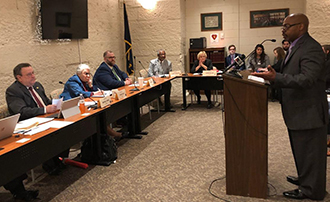
Roosevelt Glenn, Sr., a former client of Professor Watsons' clinic, testified during the legislative session about the impact the new law would have for those who were wrongfully convicted. He was released in 2009 after serving 17 years in prison for a crime he did not commit. He wrote a book about the experience, Innocent Nightmare. He told legislators what the law would mean for people in his circumstances. In the photo, Glenn is shown testifying to legislators about the proposal. (Photo courtesy of The Times of Northwest Indiana.)
"I know there are people who could really use the money this new law will provide," Glenn said. "They are really struggling. I think it's also good because Indiana should acknowledge that it makes mistakes."
As far as the amount of compensation offered, Glenn said, "It's a start for Indiana. I believe down the line we could raise the amounts."
Another Wrongful Conviction Clinic former client, Kristine Bunch, also spoke to legislators about the new law.
"I stressed to them that the bill needed to help past exonerees, as well as future exonerees," Bunch said of her testimony. She is the Executive Director of Justis4Justus, an organization that aims to build community support for exonerees through donations of goods, services, and funds.
"This new law means that exonerees will have the necessary tools to rebuild their lives and the resources to deal with the trauma they have suffered."
