

News Archive
Professor Edwards Joins Chef, Royalty, Diplomats and Students for Lectures on Pacific Cuisine and the Right to Food
06/26/2019
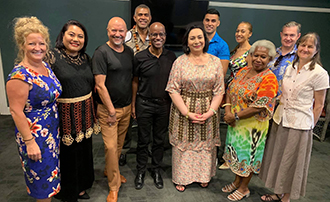 IU McKinney Professor George Edwards delivered lectures in Suva, Fiji, in conjunction with the launch of the cooking show, Pacific Island Food Revolution. The program launched and the lectures took place in April 2019.
Professor Edwards collaborated with celebrity chef Robert Oliver of New Zealand on the public lecture series to discuss food deprivation in the South Pacific, and legal and practical remedies. They co-presented three lectures titled "Climate Change, the Right to Food," "Cuisine of the Pacific," and "International Human Rights Law: Challenges and Remedies in Fiji, Samoa, Tonga, and Vanuatu." The lectures took place at the University of Fiji Faculty of Law, Fiji National University, and the University of South Pacific Faculty of Law, and were facilitated by the United States Embassy – Suva, Fiji and EducationUSA, a U.S. Department of State Affiliate.
The cooking show was Oliver's idea, and he has identified food-related problems in the South Pacific. Traditional foods have been pushed aside in local diet, replaced by low value sugary and processed foods -- junk food. Less healthful items, such as dried noodles, are being imported, displacing locally grown more healthful traditional food choices. This has led to increases in instances of diabetes, high blood pressure, obesity, strokes, the stunting of children's growth, and cancer. The World Health Organization notes that 131 million people were living with diabetes in the Western Pacific region in 2014, and that figure could double by 2030. Climate change in the region has decreased biodiversity, and has left fewer natural food options.
In the photo, Professor Edwards is at the center, Robert Oliver is to his left, with other people who appeared on the program.
Professor Edwards noted that international law requires countries to ensure that people have access to adequate, appropriate food. Obligations flow from “hard law” treaties that countries sign and ratify, and expressly acknowledge as binding. For example, countries such as Fiji are bound to the United Nations Covenant on Economic and Social Rights, and thus are obligated under article 11 to recognize the “right of everyone to an adequate standard of living for himself and his family, including adequate food’. This same article recognizes the “fundamental right of everyone to be free from hunger.”
Chef Oliver’s antidote to nutrition deprivation problems in the Pacific is encapsulated in the program, a 12-part reality TV cooking competition across the Pacific. The series lobbies for more healthful food consumption and eating, using edutainment to teach about the benefits of returning to traditional Pacific cuisine. He serves as the executive director and show host. Co-hosts are acclaimed chefs, television personalities, royalty, an Olympic athlete, and other distinguished members of the Pacific community.
The show involves 12 teams of two chefs each from Tonga, Fiji, Vanuatu and Samoa who compete in their home countries for a chance to advance to the finals in Fiji. Their challenges highlight their culinary skills and educate viewers on what is possible using traditional foods.
Professor Edwards is a professor of international law at the Indiana University Robert H. McKinney School of Law, where he is the Carl M. Gray Professor of Law. He founded the Program in International Human Rights Law, to which the United Nations Economic and Social Council in 2011 granted Special Consultative Status. He has been Visiting Fellow at the University of Cambridge Faculty of Law (United Kingdom) and Chulalongkorn University Faculty of Law (Thailand), and was a Fulbright Professor in Peru, South America. He has lectured in dozens of countries at U.S. Embassies, Consulates and other institutions on various topics, including international students coming to the U.S. to study law. His books and law articles are widely disseminated in the U.S. and overseas. He and his students have been actively involved on international criminal law cases pending before United Nations war crimes tribunals, the U.S. Military Commissions at Guantanamo Bay, Cuba, and domestic courts of various other countries. He is a graduate of Harvard Law School, where he was an editor of the Harvard Law Review and of the Harvard International & Comparative Law Journal.
