

News Archive
Professors Magliocca and Mohapatra Offer Views on Mask Requirements
06/15/2020
 A new story for The Crime Report news website at the Center on Media, Crime and Justice at John Jay College cites a paper published by Seema Mohapatra, Associate Professor of Law and Dean's Fellow at IU McKinney.
Writing in the Washington and Lee Law Review, Professor Mohapatra and co-author Robert Gatter, a professor at the Center for Health Law Studies in the Saint Louis University School of Law say that there is valid concern that "law enforcement would use mask-wearing or lack of mask-wearing as a proxy to carry out racial profiling.”
"Black Americans risk being targeted by law enforcement, [by] the employees of retail establishments, or (by) their own neighbors for wearing masks," wrote the paper's authors.
And in a separate article for the Purdue Exponent, IU Professors Gerard Magliocca and Mohapatra spoke with the Purdue Exponent for a story on mandatory mask requirements during the COVID-19 pandemic.
Despite some dissent over mask requirements, universities, including Purdue, are announcing it will be mandatory to wear a mask as plans to bring back students to campus safely are rolled out.
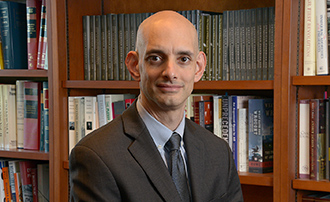 “It’s an interesting question that First Amendment lawyers spend a lot of time thinking about, (mostly) in a classroom setting,” Professor Magliocca says. “Sometimes there’s a rule that we don’t really have a great reason, but everyone agrees it should be a rule.”
He is the Samuel R. Rosen Professor at IU McKinney and the author of four books and more 20 articles on constitutional law and intellectual property.
The ubiquitous “no shirt, no shoes, no service” rule is not backed by federal law, but institutions across the country have agreed that it’s needed. Magliocca cites a U.S. Supreme Court case, Barnes v. Glen Theatre Inc., that helps explain this.
The ruling in that case, which referred to wearing clothes in public spaces in general, states such mandates further “a substantial government interest in protecting order and morality.”
Both professors agreed that if the mask policy were legally challenged, a court would rule in favor of the University.
