

News Archive
CounterClock Podcast Features IU McKinney Wrongful Conviction Clinic
05/12/2021
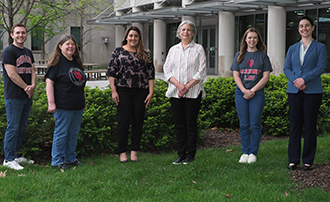 The third season of the popular CounterClock podcast highlights a case from IU McKinney’s Wrongful Conviction Clinic and interviews with Professor Fran Watson, ’80. The podcast is produced by Indianapolis-based producer audiochuck.
The latest season of Crime Junkie dropped April 29 and focuses on the Wrongful Conviction Clinic’s case: State of Indiana v. Robert Jeffrey Pelley. An episode of the CBS show 48 Hours featured the case in January 2020.
According to the state, Pelley was grounded over stealing some CDs and cash from a nearby home a few weeks before the prom in 1989 in Lakeville, Indiana. The state claimed Pelley's father grounded him and would only permit his son to attend the dance if he drove him. When the family didn't show up for services at the church where Pelley's father preached, police arrived and found four family members dead. Prosecutors declined to file charges at the time, but a new prosecutor brought a case against Pelley in 2002. Pelley by then was married, had a son, and was working as a computer consultant in Florida. A jury convicted him in 2006, and he was sentenced to 160 years in prison.
Professor Watson, ’80, has been on the case March 2009. She has recently been working on it with 3Ls Daulton Arvin, Hannah Hawkins, Cheryl Mills, and Elisa Rey-Silva.
Arvin grew up with a father who worked as a public defender. He says he jumped at the chance when there was an opening in the Wrongful Conviction Clinic. He describes working as part of the clinic as complex. “On one hand, it has without a doubt been the most rewarding experience that I have been a part of, inside or outside of law school,” Arvin said. “On the other hand, it's given me many moments of frustration and sadness not only for Mr. Pelley, but for the many others who are going through similar experiences. The constant reminder of living in a world where a human being can be unjustifiably locked in a prison cell weighs on you. At the same time, you can't help but to be inspired by not only the resilience of Mr. Pelley, but also the effort and dedication put in by Professor Watson and her colleagues. Professor Watson has dedicated an unfathomable amount of time and effort toward this case (among many others), and you can't help but to be inspired by her.” Arvin hopes to find a career path that will enable him to continue to do work similar to what he’s done in the clinic.
Hawkins became interested in the Wrongful Conviction Clinic after watching The Innocence Files on Netflix, a series that highlights Innocence Project cases. “In law school we learn that to convict someone of a criminal offense, the state must prove them guilty beyond a reasonable doubt,” Hawkins said. “However, one of my biggest take-aways from working on the Pelley case is that even when the jury is presented with reasonable doubt, there is absolutely no guarantee that a ‘not guilty’ verdict will be returned. As defense lawyers, we will have to do more than poke holes in the state's case. We will have to understand the evidence and forensics, know the good facts, and explain the bad facts. Although I have learned a lot by working on the Pelley case, the worst part of all of this is that at the end of the day, an innocent man is sitting in prison for a crime he didn't commit.” Hawkins is moving to Texas after law school and will sit for the bar exam in July. She hopes to practice criminal defense.
Reading the book Convicting the Innocent, which analyzes the first 200 cases of convicted people who were exonerated by DNA evidence, left Mills determined to become part of the Wrongful Conviction Clinic at IU McKinney. “While unraveling the layers of the Pelley case, I also learned about the post-conviction process and how to be a better defense attorney,” Mills said. She plans to pursue work in either civil or human rights after she completes her legal education.
The Pelley case is so complex that it takes up a large part of the clinic’s lab. “There are hundreds and hundreds of pages of discovery and students have completed work product for years,” Rey-Silva said. “This is not an easy case, but it is an opportunity to learn from Professor Watson, who has a wealth of experience.” She plans to graduate in December 2021.
The Pelley case came to audiochuck’s attention through Marisa Vaglica, ’20, who worked there while in law school at IU McKinney. Vaglica is an associate at Eimerman Law in Zionsville. Though not a Wrongful Conviction Clinic student, Vaglica was familiar with the case, having read the books and watched the documentary about it. After starting her job at audiochuck, she began to lean on the producers to take on a wrongful conviction. “I think you should do this wrongful conviction case,” Vaglica said she told them. “It would be an opportunity to do some justice.” They agreed. “I’m excited because I helped bring something to life and that’s cool. I’m also fascinated by this case.”
The podcast was researched and reported by investigative journalist Delia D’Ambra of CounterClock. “What got me so interested in the Pelley case,” D’Ambra said, “was the fact there is a lot of information that hasn't really been explored in my opinion. There are people close to the victims and initial investigation who still have unanswered questions about whether Jeff Pelley received a fair trial and whether or not all of the evidence was thoroughly explored.” The investigation leads to Southwest Florida, and the family’s background when they lived there.
Professor Watson is the founding director of the Wrongful Conviction Clinic at IU McKinney. She is a clinical professor of law and teaches in Law and Forensic Science, and Lawyering Practice, along with the Wrongful Conviction Clinic. In the photo from left are Arvin, Mills, Vaglica, Professor Watson, Hawkins, and Rey-Silva.
