

News Archive
S.J.D. Student Critiques International Criminal Court's Impact on Manila's Politics of Mass Murder
10/14/2021
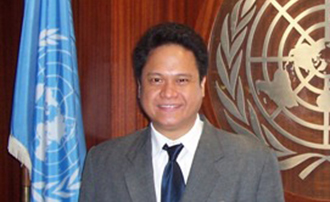 The Jurist recently published an article by IU McKinney Doctor of Juridical Science candidate Perfecto Caparas, LL.M. ’05. The piece analyzes the impact of the International Criminal Court’s investigation into cases of crimes against humanity against President Rodrigo Duterte involving the murder of 12,000 to 30,000 civilians in the Philippines.
In “International Criminal Court’s Investigation into Philippines’ Politics of Mass Murder,” Caparas explains the ICC probe counteracts the martial law practice among the police and military of arbitrarily and summarily killing alleged criminals, political dissenters, human rights lawyers, and environmental and human rights defenders. The investigation being carried out under the Rome Statute of the ICC, he said, also empowers victims of “core crimes” under Article 5 of the Rome Statute of the ICC. Provisions of the Rome Statute of the ICC and the ICC Rules on Procedure and Evidence ensure victim protection, participation, and reparations.
“The ICC probe,” Caparas writes in the article, “carries long-term political and moral significance that goes far beyond the mere criminal investigation and prosecution of Duterte and his top lieutenants who executed his state policy to kill thousands of civilians.” The investigation “challenges the police and military mindset… justifying arbitrary and summary executions as a means of dealing with criminality.”
“Duterte’s kill orders blasted into smithereens the principle of the rule of law, democratic rights and processes, human rights, and accountability,” Caparas said in the Jurist article. The ICC’s victim empowerment and investigation serve “as a counterforce to Duterte’s kill orders and state policy of widespread and systematic murder of civilians.” Together, they “form the historic wave that can potentially exorcise Duterte’s vicious legacy of mass atrocities.”
After winning the May 9, 2016, presidential elections, Duterte repeatedly exhorted the police, military, and populace to murder civilians, prompting Caparas to condemn the skyrocketing number of targeted killings as constituting crimes against humanity of murder outlawed under the Rome Statute of the ICC. Hoping to help quell its rising tide, he tried and helped raise awareness and galvanize action against the mass killings in his lectures in the United States and Ireland, as well as writings, including the ones published in Rappler, which the government later slapped with multiple harassment suits for its critical reporting on Duterte’s so-called “war on drugs.”
Caparas called on the ICC Chief Prosecutor to open a preliminary examination and later a preliminary investigation into the targeted killings during an NGO side meeting to the 16th session of the Assembly of States Parties to the Rome Statute of the International Criminal Court held on December 7, 2017, at the United Nations New York Headquarters. In his lecture delivered at the Maynooth University Department of Law in June 2018 in Ireland, he also appealed to Pope Francis to officially denounce the widespread and systematic killings. He asked the Vatican to “call upon the Church and the people to resist” the targeted killings. He also urged the U.N. General Assembly to “declare a state of grave human rights emergency in the Philippines and create a fact-finding mission.”
On September 15, 2021, the ICC Pre-Trial Chamber I granted then ICC Chief Prosecutor Fatou Bensouda’s request to carry out a preliminary investigation into cases of crimes against humanity in the country.
