

News Archive
Carlton Martin, '12, Serves as Pro Bono Manager, Counsel at National Homelessness Law Center
11/01/2021
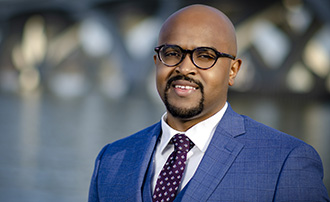 Perhaps the path that led Carlton Martin, J.D. ’12, to his role as Pro Bono Manager and Counsel at the National Homelessness Law Center in Washington, D.C., began while he was an undergraduate student at IU Bloomington. Martin received a Bachelor of Arts in Sociology/African American and African Diaspora Studies. He wasn’t necessarily thinking about a career as a lawyer, but key people in his life urged him in that direction.
“Once that happened, I was really motivated by various historical figures, the Civil Rights Movement, and the role of lawyers throughout our history in our country,” Martin said. He took an undergraduate law class at IU Bloomington, did well in it, and began to see law school and a career as a lawyer as a possibility.
A successful career in public interest law wasn’t necessarily top of mind while Martin was completing his legal studies at IU McKinney. He was thinking about pursuing a career at a big law firm. “I was like any other student,” Martin said. “That’s a very enticing road to go down when you don’t know so much when you begin law school.”
Martin began his legal career as an attorney and coordinator for the Neighborhood Christian Legal Clinic and its Project GRACE (Guided Re-entry Assistance and Community Education) initiative. In that role, he served formerly incarcerated people and homeless veterans who needed help with driver’s licenses, expungement, family law matters, bankruptcy, housing, and public benefits advocacy. From there, Martin worked as a deputy public defender for the Public Defender of the State of Indiana before serving as a staff attorney for the Indiana Supreme Court. At the court, he managed two major projects. The Coalition for Court Access provides an organizational structure for the state’s civil legal aid programs and pro bono delivery, and the Indiana Conference on Legal Education Opportunity (ICLEO), which helps minority, low-income, and educationally disadvantaged students with pursuing a law degree in Indiana. Regarding ICLEO, in a lot of ways Martin had come full circle: He was an ICLEO Fellow in Summer 2009 before attending IU McKinney. While at the Supreme Court, Martin also drafted a rule to expand the pool of pro bono attorneys in the state.
Given this history, it’s no surprise that Martin is now serving as the pro bono manager and counsel at the National Homelessness Law Center, where the motto is “we’re the only legal organization that’s dedicated fully to ending and preventing homelessness and defending the rights of people who are homeless.” “You hear ‘end homelessness’ and that seems impossible, but it really isn’t,” Martin said. “Some communities are models to follow. New Orleans got their homeless veteran population down to zero. It can be done.” The center is a small organization with a national and sometimes international mission that relies on pro bono support to expand its efforts, Martin said. He coordinates with some of the largest firms and businesses in the United States to help with the center’s litigation and expand its efforts. Part of his role is to serve as an intermediary between outside counsel and the center’s counsel. The other part involves traditional lawyer work: amicus briefs, lobbying with a small “l” with different groups to advance the center’s causes, and advocacy work.
Courses at IU McKinney definitely played a role in Martin’s career path and current success.
Professor Fran Quigley’s Civil Procedure course got Martin started on firm footing. “I remember thinking it was going to be a dry subject, not a lot of excitement,” Martin said. “He made it interesting.” Knowing federal rules seemed like an exercise in memorization, but that’s part of what Martin does now in his career. “The experience with him,” Martin said of Professor Quigley, ’87, “that’s where the relationship started. Liking him made me like that class.”
Professor Florence Roisman’s Civil Rights course also played a role in shaping Martin’s path. “What we do has a civil rights component to it, especially with regards to race. Over 40% of the homeless currently are black, and 20% are categories of people of color. That brings race into it. Systemic racism is a root cause of homelessness, so that class was definitely important.”
Professor Carrie Hagan’s Civil Practice Clinic is where Martin worked with clients for the first time. Martin said he negotiated a dissolution of marriage case between an Indiana and Florida resident and helped lower his client’s arrears payments from an unreasonable amount to a workable one. “I will always remember my clinic experience because it was the first time that lawyering was real,” he said. “A flesh-and-blood person was sitting across from me with a problem and needed solutions. No more theory, just action.”
