

News Archive
IU McKinney Program Takes Aim at Easing Lawyer Shortage in Rural Indiana
08/16/2023
 Rural Indiana has a lot going for it. Quaint small towns. Rolling crop fields. Pastures dotted by grazing livestock. Neighbors who know one another and look out for each other’s well-being. But those neighbors sometimes get into disputes and occasionally there are criminal issues to resolve. There is a dire shortage of attorneys who work in rural communities across the state. In fact, residents of some places in Indiana only need one hand to count the number of lawyers in their midst. IU McKinney’s Supporting Rural Justice Initiative is a significant step toward alleviating that shortage.
Summer 2023 marked the fifth year for the program and seven students took part. They are Jerrick Adams, who worked with Huntington County judges; Daniel Bohnet, who was assigned to work in the Rush County Public Defender’s Office; Alexa Campbell, who was assigned to the Warren County Prosecutor’s Office; Emily Dartt, who worked with Washington County judges; Nathan Lundy, who was assigned to assist DeKalb County judges; Mario Reyes, who worked with White County judges; and Shelby Rice, who worked for the Montgomery County Public Defender’s Office.
Jerrick Adams is a 2L from Albany, Indiana, about 75 miles northeast of Indianapolis. He grew up there on what he terms a 40-acre hobby farm, and now lives in rural Huntington County, just outside Warren. He said his mother’s family has lived in rural Delaware County for more than 60 years, his father’s family has lived in Jay County for longer than that, and his wife’s family has farmed in Randolph County for generations. “Put most simply, these places, and the people who populate them, are more than dear to me. My affection for them is marrow deep,” Adams said. “Ambitious as I am in many respects, it has never been my ambition to leave rural Indiana and make my way in ‘the city.’ Rather, if I am to make my way in the law, it will be in places like these, serving the interests of the people for whom I care so deeply.”
 During his summer in the Supporting Rural Justice Initiative, Adams said he gained a fuller understanding of the unique challenges faced by courts in rural settings, as well as a solid grasp of criminal and civil trial practice and procedure. “Moreover, I've met so many wonderful people, including the judges I was placed with, the court staff, and the attorneys who practice in Huntington County and surrounding areas,” Adams said. In the photo from left are Judge Jennifer Newton, J.D. ’02; Judge Davin Smith; Adams; and Magistrate Amy Richison.
Huntington County Circuit Court Judge Davin Smith, J.D. ’03, is taking part in the program for the second time. Judge Smith is a Huntington County native. In his court, law students spend time observing in circuit, superior, and magistrate courts before being given short research projects, assigned to work with the juvenile detention alterative initiative team or the drug court team, among other tasks.
“I believe both sides benefit from connections and relationships that are made through the process,” Judge Smith said of the Rural Justice Initiative. “My hope is that some of the clerks will see the value and benefits of a small-town lifestyle and practice of law, and that they will look for those types of opportunities in the future.”
White Circuit Court Judge Jason Thompson has taken part in the program in previous summers. He grew up on a farm in Idaville in the county and knew he wanted to set up a legal practice in Monticello after completing law school. Law students who work with him as part of the program perform research and analysis on specific legal topics or questions, update local court rules and courthouse security plans, maintaining court employee policy and handbook, and review certain case types for 41(E) issues.
“I really hope this program helps our local law school students think about returning to their hometown community and serving,” Judge Thompson said. “They are seeing the need for good legal representation, as well as getting a behind the scenes look at judicial administration in rural counties.”
Law students do indeed want such opportunities.
“I wanted to take part in the Supporting Rural Justice Initiative because I, myself, am from a rural community and have worked within rural communities all my life,” said 3L Emily Dartt. She’s from Rockport, Indiana, in Spencer County. “I understand the need for more legal representation in underserved areas and found myself compelled to contribute in some way. The program provides an opportunity to gain valuable work experience while serving an underserved community.” Dartt worked for Judge Dustin Houchin, J.D. ’03, and Judge Larry Medlock in Washington County. “I feel I truly lucked out. Judge Houchin, Judge Medlock, their court reporters, and everyone I have encountered during my time in Salem welcomed me with open arms, and I am very grateful for the opportunities I have been presented with. At the end of the program, I walked away with more confidence, enhanced research and writing skills, and some new friends.”
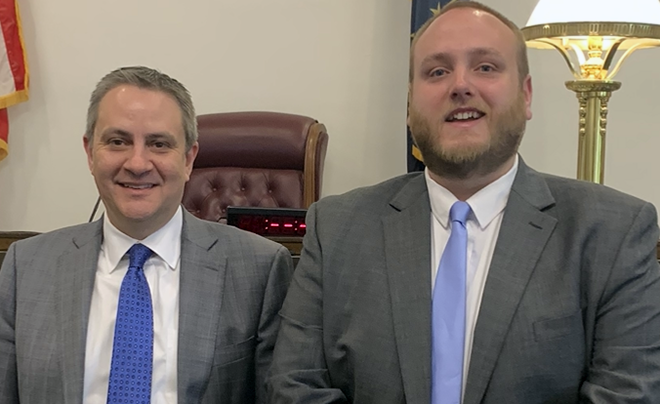 Nathan Lundy is a 3L who plans to complete his legal education in December 2023. He’s originally from Huntington, Indiana, in Huntington County. He was encouraged to attend IU McKinney by his late-grandfather’s law partner, Tim Bloom, J.D. ’78. Lundy learned about the real-world opportunities, like the Supporting Rural Justice Initiative, that would help him learn how to practice law once he completed his legal studies. Lundy wanted to take part in the program “because I wanted the opportunity to see the practice of law from a different perspective,” Lundy said. “Especially knowing I want to practice in a small community as well made this an ideal opportunity and learning experience. There is an innate nature of practicing law, particularly in a small community, that means you are making positive and meaningful impacts in the lives of real people.” In the photo at left is Lundy (right) and DeKalb County Superior Court Judge Adam Squiller.
Making a meaningful impact in the lives of others is part of what drew 2L Mario Reyes to the program. Reyes is originally from Brownsville, Texas, but grew up in Monticello, Indiana, in White County. Reyes is a veteran of the U.S. Army and was drawn to law after completing his military service. Having lived in Monticello, Reyes said he thought his familiarity with rural Indiana would be an asset. “I also knew the Latin population has grown significantly in White County,” Reyes said. “A lack of attorneys in the rural areas of Indiana is enough of a hurdle for the general population but it is a Herculean obstacle for those that do not speak English and have limited financial resources. Being bilingual, knowing the area, and having a desire to be of aid to others all made me feel like the Rural Justice Initiative was a great fit for me.”
Shelby Rice is a 3L from Paoli, Indiana, in Orange County. Rice said she decided she wanted to become a lawyer because she witnessed firsthand the need for attorneys in rural communities. “As I grew older, the attorneys in my area grew more scarce,” she said. “I witnessed what can happen to people when they aren't represented by competent counsel and do not have the option to hire an attorney. I wanted to take part in the Rural Justice Initiative to gain more knowledge about why so many attorneys are leaving rural areas and what issues plague the rural community in Indiana. I wanted to gain experience in working in rural communities so that hopefully, when I go back home, I am able to make a difference.”
The communities where IU McKinney students serve also benefit from the program. Fountain County Circuit Court Judge Stephanie Campbell, J.D. ’96, regularly takes part in the Rural Justice Initiative. She grew up in Veedersburg in Fountain County and knew she wanted to return to rural life after attending Butler University for her undergraduate studies and IU McKinney for law school. Law students under her wing draft orders, sit near the bench during court proceedings, help her with legal research, and attend at least one session of the county’s problem-solving court. Students also shadow the county prosecutor, a community corrections officer, a public defender, attend a mediation, tour the county jail, and ride along with a law enforcement officer.
“My hope is that law students will come to understand they can earn a great living practicing in a rural county but also have a legal experience early on in their career that they may not get in an urban setting,” Judge Campbell said. “Whether they are interested in criminal, civil or probate law, there are clients in these counties to represent and a wonderful community of experienced attorneys willing to help guide them as they are learning the ropes.”
The Rural Justice Initiative factored into 3L Alexa Campbell’s decision to enroll at IU McKinney, she said. This is Campbell’s second year taking part in the program. The daughter of Judge Campbell, she grew up in Veedersburg (population 2,500) watching her mother’s legal career unfold. Campbell said she wanted to pursue a profession she knew would benefit her community and she hopes to join a practice in Fountain County or another nearby rural county after completing her legal education. “Being an attorney that people can trust to represent them during some of the hardest times in their lives is what I want to do,” she said.
The Supporting Rural Justice Initiative began in 2019 by placing students with judges in rural counties but has since expanded to include placement of rising third-year students as certified legal interns with prosecutor and public defender offices in rural counties. Law students commit to working at least 200 hours for which they receive three experiential learning credits and a $4,000 stipend. The IU Maurer School of Law also has a Supporting Rural Justice Initiative program.
