

News Archive
IU McKinney Alumnus's Book Examines History of the Episcopal Church in Indianapolis
06/13/2024
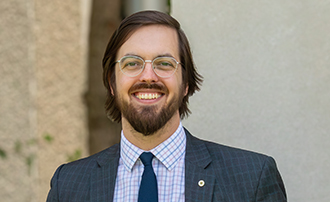 Lee Little, J.D, ’16, research and instructional services librarian and lecturer in law in the Ruth Lilly Law Library at IU McKinney, has published his second book. Titled Changing Mission, Unchanging Faith: Episcopalians and Influence in Indianapolis, the book looks at the ways the Episcopal Diocese of Indianapolis has changed from one of the most traditional and conservative religious groups in the city to one of its most progressive.
Little is no casual observer of this history. Indeed, it’s a passion of his. His first book, Circle City Steeples, was published in 2021. He serves as the historiographer of the Episcopal Diocese of Indianapolis and is passionate about the city’s local and religious history. In a lot of ways, those two passions are combined in this work.
“The big thing that hangs over all of this is Eli Lilly,” Little said. “He was an Episcopalian and gave dozens of millions of dollars to the church in his will. When he died, he donated $6 million each to two different Episcopal churches, and $13 million each to Christ Church Cathedral and the Episcopal Diocese of Indianapolis, in addition to all kinds of other charitable causes.” It was the largest non-royal gift to an Anglican or Episcopal church in history, Little says, and it is likely to remain so because of the decline in people’s attachment to religious institutions.
Even though the Episcopal church in Indianapolis was quite small, it had a great deal of outsized political influence, Little says. “In the book, I try and focus on its conservative and small origins and its growth to one of the more liberal.”
The book considers the era of the Ku Klux Klan and when it came into power, particularly among protestant denominations that didn’t possess the ties to systemic power enjoyed by better-connected churches. “There was a disconnect between the power structure of the Episcopal church and how they viewed the social order and what was going on on the ground surrounding issues of race, class, and ethnic background,” Little said. “I view that as the separation point.”
The progressive changes in the church were not met happily by non-clerical leaders in power, but there was no mechanism for removing priests that congregants were unhappy with, Little said. Priests were therefore at liberty to preach for progressive reforms, such as racial integration. The powerful made their sentiments known publicly, but there was little they could do to stop it.
“Today’s members remember these people,” Little said of those who lobbied heavily against progressive reforms. “They still hold sway even though they’re dead. If we really want to do the work as a church, we have to grapple with that.”
The book has been published by Seabury Books, a division of the Episcopal Church’s publishing. Bishop Jennifer Baskerville-Burrows, leader of the Episcopal Diocese of Indianapolis, wrote the forward.
