

News Archive
Meet IU McKinney Alumnus Nathan Lundy
09/18/2024
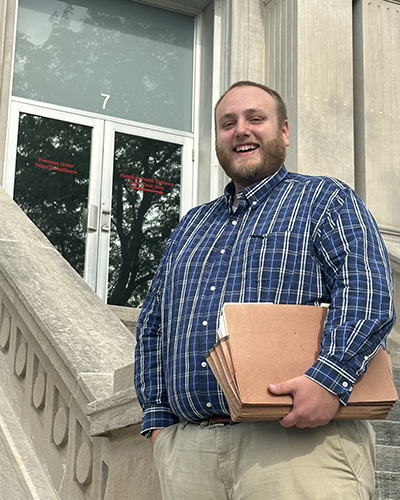 Nathan Lundy, J.D. ’23, took part in IU McKinney’s Rural Justice Initiative while in law school. He now works as an associate attorney at Bloom Gates Shipman & Whiteleather in Columbia City, Indiana.
Where did you do your undergraduate studies and what did you major in?
I went to Butler University and graduated in December 2018 with a major in Religious Studies and a major in Political Science. Prior to coming to law school, I also graduated from Wesley Theological Seminary in Washington, D.C., in May 2021 with a Master of Arts, specializing in Public Theology.
Did you work before coming to law school and if so, where?
I began working for my current firm, Bloom Gates Shipman & Whiteleather, in 2014-2015 during my senior year of high school. I took part in a program the school offered where I could take half days that last year if you were far enough ahead on your required credits for graduation. I started out as an intern who answered phones and ran errands during high school, transitioned into more of a legal intern in college doing some drafting of documents and legal research, and was then a Graduate Legal Intern after law school and was given bigger projects and began meeting with my own clients. I’m now an associate doing general practice, general litigation, estates, public defender work, little bit of everything. I worked at other jobs in college, including at a daycare and at a movie theater. I spent time at a medical malpractice firm in Indy during my 1L summer. It was a great experience with great people and attorneys, but it solidified for me that I wanted to practice in my community of Whitley County.
What appealed to you about the Rural Justice Initiative? What made you want to take part?
What initially appealed to me about the Rural Justice Initiative was the ability to get practical exposure in a rural community. By the time I found out I was accepted into the program, I knew that I wanted to come back to Whitley County to practice. So, it was a perfect fit to be able to see how to be an attorney in that type of context. The Rural Justice Initiative was something that I could do closer to home in Northeast Indiana, where I could gain a greater contextual understanding of practicing as an attorney in my corner of Indiana and outside Marion County. Knowing that I didn't want to stay in Indianapolis, I was looking for opportunities where I could get closer to the environment and context where I knew I would one day be practicing. I found that many of the experiential opportunities McKinney offered were in Marion County or with the state government. Certainly not a bad thing, just an observation. The Rural Justice Initiative was uniquely different compared to the other opportunities available.
What did you enjoy most about the program?
I enjoyed the experiences I was able to observe and the connections I was able to form. Simply, I saw how to be an attorney: how to communicate with the judges and court staff, with other attorneys, with clients. I was placed with each of the three courts in DeKalb County, so I was fortunate to see a little bit of everything. I was blessed to be able to learn from each of the judges and their staff, and many of the attorneys that appeared in each court. I was also able to observe a wide variety of hearings and trials, including a week-long, criminal jury trial, and the three problem-solving courts in the county. What I enjoyed most was knowing that my experience while taking part in the program would be a direct benefit to my own practice in a rural community.
What do you wish people knew about the rural parts of the state?
Real people live in the rural parts of the state, and they have real problems that can be aided by the assistance of an attorney - especially if they're an attorney in the client's own community. What I wish people, especially young attorneys or recent law school graduates, knew was that there is certainly a need for good work to be done for folks in their own communities across the state.
Photo by Matt Shipman, J.D. ‘98
