

News Archive
Meet IU McKinney 2L and Art Event Winner Edward Null
03/12/2025
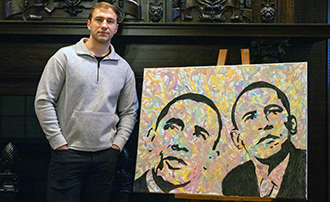 Edward Null is a 2L at IU McKinney who won the student category in the third annual art event at the law school. Null won for his painting titled Polychromatic Obama Diptych and received a diploma frame.
Where did you do your undergraduate studies and what was your major?
I received my undergraduate degree from Purdue University, West Lafayette. At Purdue, I majored in neurobiology and physiology and received minors in chemistry and philosophy.
What brought you to law school? Why did you choose IU McKinney?
While I thoroughly enjoyed my time studying biological sciences, I often cite my experience with philosophy as the most influential factor in my decision to attend law school. At Purdue, I took several courses under Professor of Philosophy, Daniel R. Kelly. In particular, I took his course “Moral Psychology and Climate Change” at the same time that I enrolled in my first political science course on environmental law. Professor Kelly’s course focused on the ethical challenges posed by climate change in conjunction with the deep cognitive and motivational factors that shape our collective responses to it. During this time, I developed a strong belief that an interdisciplinary education is a crucial aspect to intelligently approaching policy making and shaping the legal frameworks that our collective future is founded upon. I concluded that a degree in law would provide me with the most pragmatic means of actualizing this goal. Accordingly, I decided to attend IU McKinney because of its esteemed health law program. I believed that using McKinney’s health law resources would effectively build upon my existing health-science experience and develop my ability to understand the ethics related to this subject matter.
Where does your interest in art come from? I believe you said that you have no formal training. When did you begin creating art? What medium do you prefer?
I have been interested in art and the creative process since I was a child. Some of my fondest childhood memories were moments where I was drawing and painting. In my youth, my parents also helped me understand the possibilities of art by taking me to places like the Chicago Art Institute, the Louvre, and the Vatican Museums. As I matured, I began to understand the utility of artmaking, and the role it plays in bridging cultural divides and demarcating periods of history. I have never received formal art training however, my father is a hyperrealist portraitist who taught me the fundamentals of drawing. In 2019, I then met my father-in-law who introduced me to the world of abstract expressionism. After informally apprenticing under my father and father-in-law, I have spent the last five years focused on improving my compositions and producing voluminously. I paint on canvases if I have them, but I often paint on cheaper poster material out of necessity, or whiteboards, where I end up erasing my work. I typically use a combination of acrylic and spray paint, but I have also used pencils, markers and pastels to obtain the final image I have imagined.
Please describe your creative process, if you would. Where does your inspiration come from?
My creative process is probably best described by Charles Bukowski’s poem, “so you want to be a writer?” In that poem, I believe Bukowski’s description of the creative writing process can be effectively translated into the visual art context. A vast majority of my art comes from a strong momentary compulsion to create, which usually results in an improvisational process. This is why I typically will only spend two or three hours beginning and finishing a particular painting. This method makes the act of painting much more performative, which I believe yields a more vulnerable and honest end product. Generally speaking, my inspiration is drawn from other great artists, musicians, close acquaintances, or people who I believe have made a positive impact on the world. I have found that regularly reflecting on the ways I have been emotionally moved by others or their work, is an effective way to personally grow into a better, and more diversified person.
Do you have a favorite piece and if so, please tell me about it.
The piece that has had the greatest influence on my work is Jackson Pollock’s 1946 painting, “The Key.” I also personally enjoy the works of Johannes Vermeer, Robert Nava, Mary Cassat, and Jean-Michel Basquiat, to name a few amongst many others. My favorite painting of all time was made by my father-in-law, Glenn Lewis, and it is titled Living Beyond All Warning. Glenn’s painting has helped me understand the wonders of artistic expression and has taught me the indispensable importance of connecting with others through art.
