

News Archive
Law School’s Immigration Clinic Wins Political Asylum for Clients
06/06/2012
Two people have been granted political asylum, thanks to the efforts of law students from the Indiana University Robert H. McKinney School of Law. One is a young woman who was subjected to female genital mutilation (FGM) and at age 15 fled to the United States rather than enter into a forced marriage with her cousin who was nearly 40 at the time. The other is a young man who feared persecution in his native Zimbabwe because of his HIV status.
 Zoe Meier, ’12, was the student who worked on the case of the young woman, along with Immigration Clinic Director, Professor Linda Kelly Hill (pictured, left). The woman’s mother objected to her daughter being subjected to FGM, but “the ‘ceremony’ was performed by our client’s aunt, the sister of our client’s father,” said Professor Kelly Hill. “Our client testified her mother had always prayed ‘May God protect you from the knife.’”
When the woman turned 15, her aunt and father began planning for her to marry her cousin, her aunt’s son. The woman’s cousin was nearly 40 years old then, already married to three other women and known for abusing these wives. With her mother’s help, the woman fled to the United States.
Her claim for asylum was made upon her subjection to FGM and her fear of forced marriage, tribal banishment and other reprisal by her father for refusing to marry. The case included U.S. medical documentation of the woman’s subjection to FGM.
Regardless, the woman’s asylum request was denied by the Department of Homeland Security (DHS) Asylum Office in Chicago based on an adverse credibility determination. Credibility is often a contentious issue in asylum, according to Professor Kelly Hill.
The woman was referred to Immigration Judge Virginia Perez Guzman in Chicago. Meier was responsible for all cross-examination, document filing and witness preparation before Judge Guzman. Meier continued in her assistance of the client on a pro bono basis after completing her graded clinical work in 2011.
It was a responsibility Meier felt deeply. “For the client, I wanted to somehow convey to her that yes, she was a client, but she was also a person whose future I cared about and I thought about through every moment of preparation for her case. It weighed on me,” Meier said. “I questioned whether I should really be responsible for her future as a student and finally I realized that all we can ever do is prepare mentally, emotionally, and with obsessively organized precision. It was an amazing experience to test my skills and confirmation that I loved immigration law.”
Judge Guzman recognized that the woman merited asylum. She ultimately found the woman to be credible, Professor Kelly Hill said, due in large part to Meier’s successful cross-examination of the DHS impeachment witness.
Meier’s client, who has asked to be referred to as Fatoumata N., has nothing but positive things to say about the all the law students who worked on her case.
“When I had questions about the case, I texted, called or e-mailed,” she said. “Actually, it was easier working with them because they are students like me and I understand the pressure they are under.” She is currently studying human resources management and international relations. 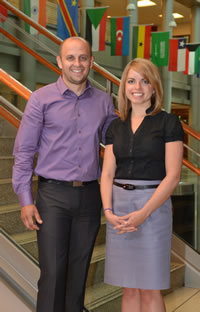
Two other Immigration Clinic students, Serge Zaitseff, ’12, and Aimee Heitz, ’12 (pictured, right), won asylum on behalf of a client from Zimbabwe. Asylum was awarded based upon the client’s HIV-positive status and his “well-founded” fear of being subjected to persecution due to his HIV status if he returned, the professor said. In so ruling, Immigration Judge Eliza Klein recognized HIV-positive individuals form a recognized “social group” subject to persecution directly by the Zimbabwean government as well as subject to societal persecution condoned by the state. In short, the judge declared that “returning the respondent to Zimbabwe would ‘be a literal death sentence.’”
Heitz and Zaitseff started working on the case in January 2012, and the case accelerated from there because the client had been detained.
“We were happy with the result,” Heitz said. “It was a rewarding experience.”
The victory is particularly significant as the man had been detained by federal immigration authorities for seven months; unable to pay a $3,500 bond set by the federal government. “Ms. Heitz and Mr. Zaitseff were required to prepare and work with our client under the terrific communication challenges presented by his ongoing detention and transfer (without notice) between three different facilities in Wisconsin and Illinois,” Professor Kelly Hill said. In February, the asylum hearing was conducted in an immigration courtroom designated for detained individuals. It was the first chance the students had to meet their client in person.
Immigration Clinic evidence established the man’s fear of persecution, and also persuaded the judge of the severe “ostracism and condemnation of those affected by HIV/AIDS” in Zimbabwe, including that extended families often refuse to take in orphans for fear of contracting the disease. The judge noted instances where the government had been involved in “direct attacks” against the HIV-positive population of Zimbabwe. The client has been released and is now living safely in the United States.
Immigration Clinic students actively represented approximately 50 people during the 2011-2012 academic year. This student work included representation of applicants for asylum, U Visas (crime victims), T Visas (sexual trafficking), Violence Against Women Act (VAWA), Temporary Protected Status (TPS), Deferred Action, U.S. citizenship, and various other petitions. “The legal assistance provided by our students immeasurably changes our clients’ lives,” Professor Kelly Hill said. “I wish them all the brightest of futures.”
In addition to Heitz, Zaitseff and Meier, Immigration Clinic students who graduated in 2012 included Erika Blinks, Saulo Delgado, Rachael McCarthy, Jared Prentice, and Mercedes Rodriguez.
