

Civil Practice Clinic Students File Amicus Brief in Expungement Case
05/03/2022
 Students in IU McKinney Professor Carrie Hagan’s Civil Practice Clinic have been granted permission to file an amicus brief in yet another expungement appeals case, Deon Willford v. State of Indiana. The Indiana Court of Appeals granted their request April 8. This brings the total of allowed appearances as amicus to four for the Civil Practice Clinic, including one where they argued in front of the Indiana Supreme Court.
Willford deals with expungement of a high-level felony where, based on the type of felony, the petition may need to seek consent from the State before they are allowed to file for expungement. Generally, in Indiana, there are five categories of expungement and the most difficult are higher-level felonies of two types. Category 4 is the second highest level of expungement. Felonies that are A, B, or C (or F1, F2, F3, F4, or F5 under the new classifications) where there is no serious bodily injury fall into Category 4. Category 5 is the highest level of expungement and encompasses all the same categories of felonies where there is serious bodily injury. In this category, the person must receive permission from the prosecutor in the county where the conviction took place and if the prosecutor does not consent, the petitioner may not file. For both categories, even if the court grants an expungement, the conviction still appears on the person’s record “marked as expunged.”
Willford was convicted of a high-level felony, but he was not convicted of a crime which included serious bodily injury. As such, Willford, his attorneys and the Civil Practice clinic argue that this placed his conviction in Category 4, requiring eight years to pass from the date of a person’s most-recent conviction before a person may petition the court for expungement and not requiring consent from the state to file. When he filed for expungement, Willford filed as Category 4. In response, the Marion County prosecutor, where the conviction happened, argued it should have been filed as a Category 5 due to the inclusion of a charge of bodily injury (which did not result in conviction). At a hearing on the state’s response, the trial court stated that if it found serious bodily injury in the underlying cause that the prosecutor’s consent would be required. In its order, the court found Willford was allowed to proceed with the expungement of his other convictions but that since “ordinary injury” was also alleged, he would need the state’s consent to proceed with the expungement of the felony.
“This issue illustrates a problem of statutory interpretation and what we are able to advise our clients on when it comes to expunging high level felonies,” Professor Hagan said. “We believe that unless someone was convicted of a crime that contains serious bodily injury, they can proceed with a Section 4 – the mere presence of bodily injury in the underlying facts or a charge involving bodily injury that they weren’t convicted of isn’t enough to move it to a Section 5. We have gotten varying answers about this when we consult with prosecutors – sometimes they seem to agree with our stance, and other times they don’t, and we are unclear as to why.”
The clinic, as part of its work during the academic year, routinely checks for appeals that are filed relating to expungements. If there is an appeal that presents an issue that the students believe merits attention, the class works together to reason through the issue, what arguments need to be made and what impact their work could have for their clients going forward. For the Willford appeal, the clinic was actually contacted by a former Civil Practice Clinic student, Evan Strater, ’19, who asked for the clinic’s take on the case having learned of the clinic’s prior work as amicus. After working through whether appearing as amicus would make sense, clinic student Anna Cron took on responsibility for writing the brief, and Brittany Roberts assisted with reasoning and all technical aspects of the filings. Once drafts of the brief were prepared, the entire class reviewed and provided comments and suggestions, along with another former clinic student, Katelyn Juerling, ’16, who ended up signing on with the clinic as co-counsel for the amicus brief.
“The work product the Civil Practice Clinic has produced in this case exceeded my expectations in every way,” Juerling said. “The students in this clinic will make significant contributions to the practice of law in this state. If they are already producing this type of work product as students, the sky is the limit for them down the road. That excites me and should excite every practitioner in this state. It has been a pleasure assisting these students on a ‘co-counsel basis.’”
The opportunity means a lot to Roberts. “The chance to jump into the clinic and assist in the filing of a brief of amicus curiae in the Indiana Court of Appeals has been a highlight of my time here at McKinney,” Roberts said.” I was able to assist with the drafting of the documents that were filed and help Anna refine her well-articulated argument. At first, I was not sure that our argument was strong or a new perspective on the issue. After weeks of research and contemplating involvement, I realized how important clarification on the statute’s interpretation from the Court of Appeals will be not only for our clinic work going forward but for expungements statewide.”
Working in the clinic and on the amicus brief has been significant for Cron, too. “My time working with the Civil Practice Clinic has been the most meaningful and impactful experience of my time in law school,” Cron said. “I have been able to put into practice what I’ve been learning and to make a difference for people. I chose to pursue a law degree to help people and the work our clinic does just that by helping people seek safer housing, better job placement, higher education, and more.”
The ability to help Indiana residents change their lives for the better is what attracts Juerling to this kind of work. “I got involved with this project because I am passionate about the opportunities that our state’s expungement can provide for those in need. In my practice over the past five years, I have had the opportunity to help several individuals with record expungements, and I know that it is important and life changing work for Hoosiers,” Juerling said. “I thought my real-life experiences with expungement cases could assist the clinic, and I wanted an opportunity to learn more about the appeals process as well as amicus curiae brief writing. This whole experience has been mutually beneficial, and I am proud to be a part of it.”
Professor Hagan is grateful to the appellate court for allowing the clinic to file as amici in the Willford case.
“All in all, we are just grateful for the opportunity to reason through these things as a class, and with the state as we practice generally on expungement, as in doing so, we believe we can make positive differences for our clients going forward,” Professor Hagan said. “We also really appreciate the court allowing us to appear as amicus, as we realize that is discretionary, but the learning value for the students in being allowed to appear is tremendous.”
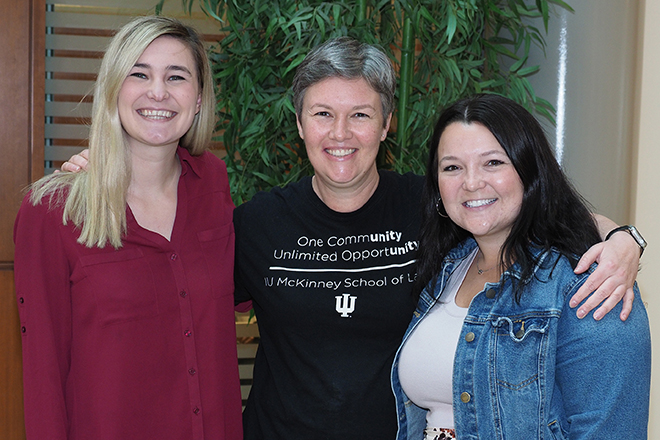
In the photo from left are Anna Cron, Professor Carrie Hagan, and Brittany Roberts.
