

News Archive
Military Commission Observation Project Celebrates First Anniversary
04/23/2015
The law school’s Program in International Human Rights Law (PIRHL) marked the first anniversary of its Military Commission Observation Project (MCOP) during Spring 2015. Several IU McKinney students, faculty, alumni and staff have taken advantage of the opportunity to witness the proceedings at Guantanamo Bay, Cuba, and via video link at Fort Meade in Maryland.
The PIHRL was granted non-governmental organization observer status by the Pentagon’s Guantanamo Bay Convening Authority in February 2014, allowing it to view commission proceedings for Guantanamo Bay detainees. MCOP participants have the option of viewing proceedings through video link at Fort Meade in Maryland, or traveling to Guantanamo Bay to witness them in person.
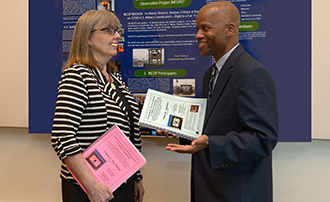 A website, www.GitmoObserver.com, and a blog, gitmoobserver.com/blog/ have been created to support the project. In addition, the Guantanamo Bay Fair Trial Manual for U.S. Military Commissions has been written since the project began a little more than a year ago. The project is also on Twitter, and can be found @GitmoObserver.
“This website has been a significant development,” said PIHRL director Professor George Edwards. He had been to Guantanamo Bay prior to the launch of the project, and has witnessed proceedings from Fort Meade since it began. “It has had thousands of visitors from all across the United States and from many foreign countries.” (Catherine Lemmer and George Edwards discuss the project, and the trial manual that has been created.)
Ruth Lilly Law Library Assistant Director of Information Services Catherine Lemmer has visited Guantanamo Bay twice as part of the project. She observed proceedings connected to the September 11 attacks.
 Lemmer was inspired to take part in the project after her work with the Legal Resources Centre in South Africa, where colleagues she worked with talked about what was going on in Cuba with the military commissions.
“I realized that my understanding of the events that were occurring in Guantanamo was very superficial and embarrassingly so given the attention the rest of the world was paying to the events happening there,” Lemmer said. She wanted to learn more, and so took part in the project. (Lemmer is shown here at Camp Justice in Guantanamo Bay.)
Lemmer said she felt like she was participating in and witnessing history as the five September 11 defendants were brought into the Guantanamo Bay courtroom.
“For me,” she said, “these defendants became human in a way that looking at photos or courtroom sketches had not previously done for me. The 9/11 defendants loom so large in our American collective thinking because of the loss of lives and destruction. When you see them separate from the visuals of the destruction and watch the process, you realize how critical it is to separate the process from their acts.”
 Hattie Harman, ’10, a staff attorney with the Indiana Supreme Court, was in the project’s first group. She traveled to Fort Meade in April 2014. A second-career lawyer, Harman did her undergraduate studies in foreign affairs and diplomacy and while she never worked in that area, she never lost an interest in it.
The Fort Meade experience was different from the experience of observing proceedings at Guantanamo Bay, Harman said. At Fort Meade, witnesses to the proceedings can only see what the camera operator shows them, and the focus is on whomever is speaking at the time. Witnesses get a glimpse of very little else, including the accused.
“In a lot of respects, it allows you to focus on what’s being said in the courtroom,” Harman said.
It’s just the opposite in Cuba.
“It’s immersion at Guantanamo Bay,” she said of her experience there in November 2014. “You’re there in it. It’s hard to get it all observed.”
It’s an experience she’s glad she had.
“If you want to find an interesting, non-traditional way to give back to McKinney, this is the way to do it,” Harman said.
 Always interested in the intersection of the law and terrorism issues, Charles Dunlap, ’96, executive director of the Indiana Bar Foundation, also has made the trip to Fort Meade and Guantanamo Bay.
Getting up to speed on the differences between military commissions and civilian courts was the first order of business for him, Dunlap said.
“The main takeaway that I have had from my experiences,” Dunlap said, “is that I believe in the vast majority of cases, using a traditional Article 3 Court to try the detainees would have been much more efficient, lower cost, faster, and easier for everyone.”
Because so much of the procedural portion of the commission is being put together as it proceeds, a lot of time is spent arguing over every procedural issue, Dunlap said. Complicating everything is that these are death penalty cases, and defense attorneys are obligated to explore any possible defense for their clients.
“The other strong impression that I left with was the delay that this whole process has caused to the victims’ families and how difficult it must be on them to be involved with this years after the actual event,” he said.
Those interested in taking part in the project can learn more and sign up to be considered to witness commission proceedings on the law school’s website.
