

IU McKinney Students Advocate for Hoosiers Facing Housing Instability
12/17/2025

Hundreds of eviction cases are filed each week in Marion County, and vulnerable households that lack legal representation are often unaware of their options. Through the Housing, Health and Human Rights Clinic at the Indiana University Robert H. McKinney School of Law, students gain hands-on experience while advocating for Hoosiers at risk of displacement.
Launched in 2015 by Fran Quigley, J.D. '87, clinical professor of law, the clinic on the IU Indianapolis campus initially helped low-income residents access health care. He quickly realized that housing insecurity was a social determinant to health. In his book, “Lessons From Eviction Court: How We Can End Our Housing Crisis,” Quigley details how evictions, frequent moves, poor housing conditions and housing instability harm overall well-being, especially for children.
(Professor Fran Quigley leads the Health, Human Rights and Housing Clinic at the IU Robert H. McKinney School of Law where students advocate for clients facing housing instability in Marion County Small Claims Court. Photo by Liz Kaye, Indiana University)
“When you’re in court, you see the mom with a baby on her hip who doesn’t know where they’re going to stay in two nights,” Quigley said. “You see the person who uses a wheelchair, and they’re getting pushed out of their home. In those moments, abstract policy concerns become very real.”
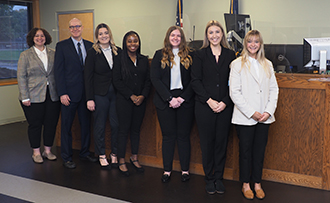 Third-year law students operate as certified legal interns under the supervision of Quigley and adjunct faculty member Megan Stuart. They take on cases that may otherwise be referred to Marion County’s Tenant Advocacy Project, which connects clients to attorneys and tenant navigators.
(In the fall of 2021, professor Fran Quigley and clinic students prepared for proceedings in Judge Garland Graves' Warren Township Small Claims courtroom. Photo by Dave Jaynes, IU Robert H. McKinney School of Law)
“The students’ involvement allows us to manage our eviction dockets with increased efficiency and integrity,” said Judge Garland Graves, who presides over Marion County Small Claims Court in Warren Township. “The ability of McKinney law students to negotiate resolutions, secure case dismissals or help a client have more time to stabilize is an indispensable asset to the court and the community we serve.”
From legal academic to court advocate
IU McKinney students Justice Vaughn, Jo Anderson and Cayla Richardson joined the clinic to get experience in the courtroom and further explore their legal interests.
Justice Vaughn int ended to go to medical school, but she pivoted to law after seeing how interconnected health outcomes are with law and policy. Her family has experienced homelessness, and she wants to ensure tenants’ voices are heard.
“In class, you learn how to think and write like a lawyer,” Vaughn said. “But you don’t know how to act like it, how to best represent yourself or clients. Being a certified legal intern gives me firsthand knowledge of how to practice law.”
In one case, Vaughn discovered that the landlord violated federal law. She said that when she raised the issue before opposing counsel and the judge, she felt a sense of newfound fulfillment and confidence being “able to tell opposing counsel, who has years of experience doing what they’re doing, ‘You actually can’t do that right now.’”
(Justice Vaughn, left, said that adjunct faculty member Megan Stuart, center, and professor Fran Quigley, right, helped her every step of the way to become a confident court advocate. Photo by Liz Kaye, Indiana University)
Jo Anderson has developed a passion for accessibility law, which intersects with housing. She uses a wheelchair and a service dog, and she has come across instances of landlords unlawfully denying reasonable accommodations in her personal life. She observed the same in clinic cases.
“I had a reasonable accommodation client this semester, and it hit me in the feels because it was something I was able to relate to,” Anderson said. “I know the Fair Housing Act and how necessary reasonable accommodations are, so I was grateful to assist my client and help them get to a resolution.”
Cayla Richardson has a heart for the homeless and is especially concerned for vulnerable populations during the winter. She wants to help Hoosiers avoid reaching that stage.
“Getting to the end of a case and having your client thank you, hug you and express their gratitude, that’s the most fulfilling and rewarding part of this experience,” Richardson said.
Research that reforms
The clinic conducts research on housing law and policy in Indiana, providing crucial insights for government institutions and nonprofits. In 2023, IU McKinney alumnus and former clinic member Jacob Purcell, J.D. '24, prepared the report, “A Decent Place to Live: Improving Indiana’s Public and Private Habitability Enforcement Mechanisms.” He examined the rise of substandard rental properties in the state in addition to the connection between poor living conditions and evictions.
The report makes policy recommendations to ensure Hoosiers are less vulnerable to predatory, exploitative landlords. His research has been highlighted by many organizations, including the Fair Housing Center of Central Indiana and the Greater Indianapolis Multifaith Alliance.
Subsequently, the clinic collaborated with the alliance and other agencies to produce the “Marion County Township Trustees: Opportunities Seized; Opportunities Missed” report. They investigated how township trustees handle requests for assistance with rent, utilities, food and medical care. Money is available to help residents, but the funds are often underused, and the denial rate is high.
According to WISH-TV, some townships took action as a result of the report. For instance, Wayne Township expanded eligibility for assistance and meets the 80% recommended assistance goal.
 As she finishes her last year of law school, Priscilla Garcia says the clinic opened her eyes to how easy it is to become unhoused. She called it a “huge injustice to Indianapolis residents,” especially when help is available but difficult to obtain. She wants to increase access to assistance and make the system a little bit easier for the community.
(As a former eastside Indianapolis resident, Priscilla Garcia, right, said that advocating for clients at Warren Small Claims Court anchored her desire to give back to the community. Photo by Liz Kaye, Indiana University)
“I would 100% recommend that students join the clinic,” Garcia said. “The phenomenal guidance you get from the faculty actually empowers you to facilitate legal solutions that truly help others.
By Nikki Livingston/IU News
